
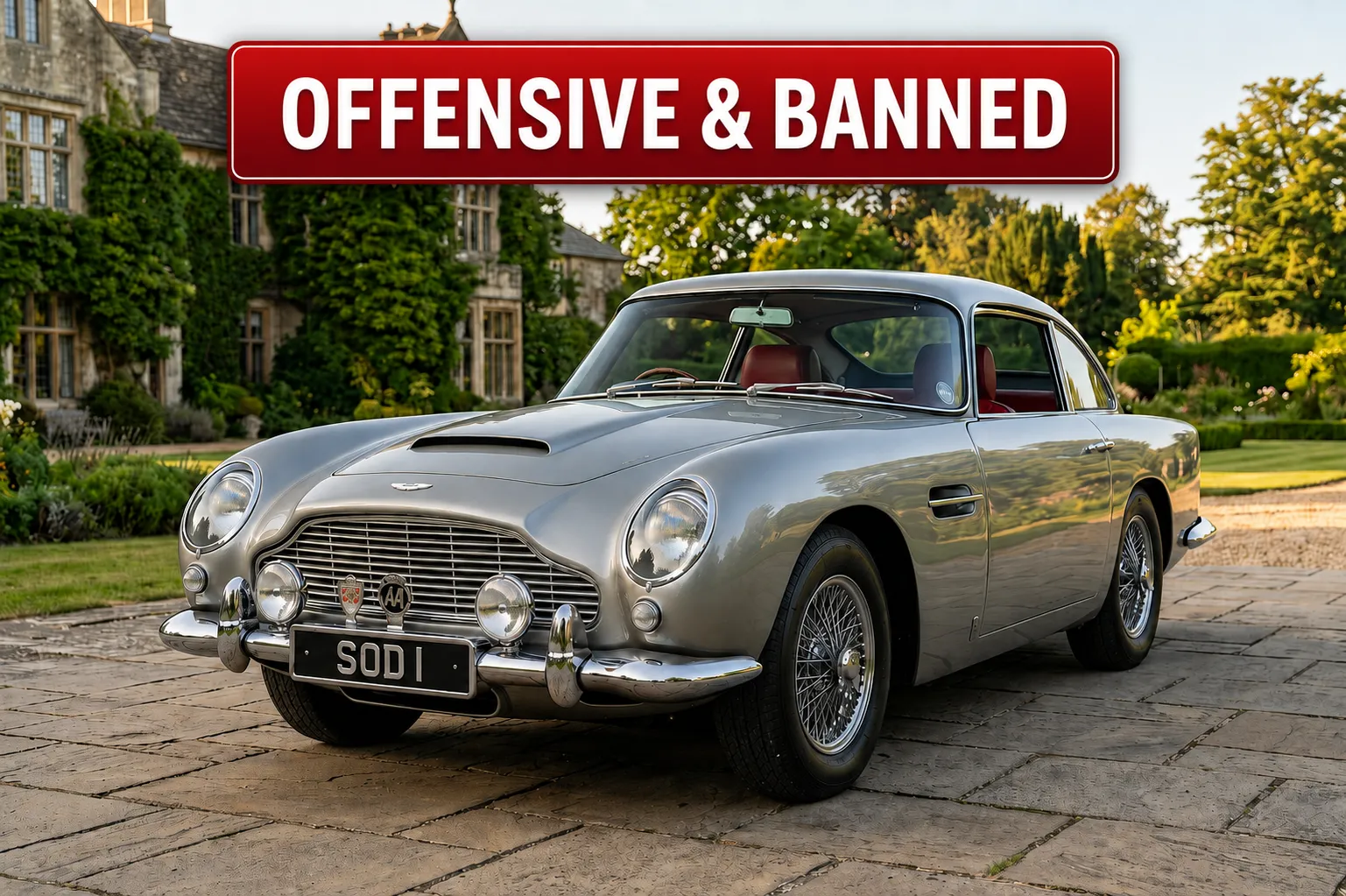
Most are fairly easy to understand. If a registration resembles a swear word, an insult or a racial slur, it is unlikely to get through. Others take a little more imagination. A harmless-looking number can suddenly resemble a letter when it sits between two groups of characters, turning an ordinary registration into something the DVLA would rather not see travelling down the motorway.
The latest 76 series is a good example. It has produced rude words, references to war and terrorism, discriminatory terms and a few combinations that are so obscure most people would probably drive past without noticing them.
Why does the DVLA withhold number plates?
A registration number exists to identify a vehicle. It is displayed in public and can be seen by people of any age, so the DVLA tries to stop obviously offensive messages reaching the road in the first place.
Its long-standing position is that the vast majority of registrations are released, but combinations that may cause “offence, embarrassment or are in poor taste” can be held back.
That normally includes apparent references to:
- Swear words and crude expressions
- Sexual terms or body parts
- Racial, religious, homophobic or other discriminatory language
- Violence, weapons, drugs and criminal activity
- Terrorism, extremist groups and war
- Sensitive historical events or current conflicts
- Direct insults and threatening phrases
The DVLA does not publish a fixed dictionary explaining every decision. Meanings change, new slang appears and a combination that looked harmless ten years ago may have a very different meaning today. Each new registration series is therefore reviewed before release.
How can numbers spell offensive words?
The current UK registration format has two letters, a two-digit age identifier and three more letters. For example, a new car registered between September 2026 and the end of February 2027 will carry a 76 age identifier.
Our brains are rather good at filling in the gaps. A 5 can look like an S, a 6 is sometimes treated as a G and a 7 can resemble a T. People may also mentally compress or overlook a character when trying to read a registration as a word.
Take AR76 RSE, EA76 DCK and FA76 NOB. All three appear on the withheld list and have been interpreted by motoring publications as crude or insulting.
They do not literally spell the suggested words, however, and the DVLA has not published an individual explanation for every entry. The readings given here are therefore the most likely interpretations, rather than official definitions supplied by the Agency.
Other registrations appear to have been withheld because of their complete message rather than a single rude word. RU76 UKR, for example, seems to refer to Russia and Ukraine, while JE76 HAD could be read as “jihad”.
How many 76 registrations have been banned?
Data supplied by the DVLA and obtained by Regtransfers lists 513 specific registrations and 10 wildcard combinationsfor the 76 series.
A wildcard is shown as an asterisk and stands for any letter in that position. *F76 GOT, for instance, does not represent just one registration. The first character can change while the rest of the pattern remains blocked.
Some wildcard combinations contain two asterisks. This means the 10 patterns account for far more than 10 individual registration numbers.
This is why different reports sometimes publish different totals. Some count the entries appearing on the DVLA list, while others attempt to count every possible registration covered by the wildcards.
One recent report gave a total of 511. However, the more detailed DVLA-supplied breakdown published by Regtransfers and also reported by WalesOnline lists 513 specific registrations plus 10 wildcard patterns.
It is also more accurate to say these registrations have been withheld or suppressed. They have been removed before issue, rather than banned after appearing on somebody’s car.
Examples of banned 76 number plates
The complete list runs to hundreds of entries, many of which are unpleasant or not immediately obvious. The following examples give a fair picture of the combinations the DVLA is looking for:
- AR76 RSE – widely interpreted as resembling a crude word
- EA76 DCK – interpreted by motoring publications as a crude expression
- FA76 NOB – appears to form an insult
- BU76 SHT – appears to resemble a swear word
- AU76 WTZ – widely interpreted as a reference to Auschwitz
- AA76 LAH – likely to have been treated as a sensitive religious reference
- JE76 HAD – appears capable of being read as “jihad”
- RU76 UKR – appears to refer to Russia and Ukraine
- YE76 MEN – can be read as Yemen
- GE76 GUN – contains the word GUN
There are also combinations apparently aimed at particular nationalities, religions or sexual orientations. We have deliberately not repeated the worst examples here. They add little to the explanation and some are exactly the sort of wording the DVLA is trying to keep off the road.
Does the DVLA always get it right?
Not necessarily—and this is where the subject becomes interesting.
Some registrations on the withheld list are obvious. Others require so much deciphering that it is difficult to imagine many motorists noticing them.
There can also appear to be inconsistencies between combinations suppressed from new vehicle registrations and those made available later as personalised registrations.
Regtransfers points to several registrations containing GUN that have previously been sold at DVLA auctions, despite GUN combinations appearing on withheld lists.
The explanation may lie in context. A random current-style registration issued automatically with a new vehicle is not necessarily treated in the same way as a personalised registration deliberately selected at auction. Even so, the dividing line is not always as clear as people might expect.
CarReg has covered banned registrations for many years. Looking back at previous lists shows how the language changes while the basic policy remains much the same. Rude words, discriminatory phrases and references to violence are regularly filtered out, but each new age identifier creates a fresh collection of possible readings.
Can you buy one of the banned registrations?
If the DVLA has suppressed a registration before release, it cannot be assigned to a vehicle and will not be available through a legitimate personalised registration search.
That does not mean every older plate that somebody might find rude is illegal. Some registrations were issued decades ago, when language and attitudes were different. Others slipped through because nobody spotted the alternative reading at the time.
An existing registration remains valid unless the DVLA formally withdraws it. The Secretary of State has the legal power to withdraw a registration mark, but a plate does not automatically become unlawful simply because somebody dislikes what it appears to say.
Is a banned plate the same as an illegally displayed plate?
No. This point is often muddled in newspaper headlines.
A withheld registration never reaches the road. The widely quoted £1,000 fine relates to displaying a registration incorrectly—for example, moving the characters, using a non-compliant font or altering a plate so it becomes difficult to read.
Official GOV.UK guidance states that the registration must be shown correctly and that its letters and numbers must not be rearranged or altered. An incorrectly displayed plate can result in a fine of up to £1,000 and an MOT failure.
Therefore, if a legitimate personalised registration resembles a name or word while using the correct legal layout, there is no problem.
What a driver cannot do is change the spacing, add a strategically placed fixing screw or use unusual lettering to force the registration to say something else.
Why are some controversial registrations still on the road?
There are several possible reasons:
- The registration was issued before the expression became widely recognised
- Its apparent meaning depends on unusual spacing that is not actually legal
- The combination was overlooked during the original review
- The apparent meaning is subjective rather than clearly offensive
- It is an older personalised or dateless registration, rather than part of a new age-related series
Screening thousands of combinations is inevitably a judgement call. Most people will agree with the obviously offensive exclusions, while some of the more cryptic choices will continue to raise eyebrows.
Choosing a legal personalised registration
The good news is that the overwhelming majority of personalised registrations are completely unaffected.
Names, initials, memorable dates, occupations, interests and short dateless combinations can all make a vehicle stand out without breaking any rules.
The important thing is to buy through a reputable source, make sure the registration is suitable for the age of the vehicle and display it exactly as the law requires.
CarReg has specialised in personalised and private number plates since 1988. If you are unsure whether a registration can be assigned to your vehicle, our team can check it and handle the transfer through the DVLA.
Search CarReg’s extensive personalised number plate database or read more about DVLA number plates.
Frequently asked questions
Why does the DVLA ban certain number plates?
The DVLA withholds combinations that could cause offence, embarrassment or be considered in poor taste. These can include swear words, insults, discriminatory language and references to sex, violence, drugs, terrorism, religion or war.
How often are number plates checked?
The DVLA reviews new combinations before the March and September registration releases each year.
How many 76 number plates have been withheld?
The detailed DVLA-supplied list published by Regtransfers contains 513 specific registrations and 10 wildcard patterns. Because a wildcard can stand for many different letters, the number of individual registrations affected is considerably higher.
Can I be fined for owning an offensive number plate?
Not simply because somebody finds an existing registration offensive. The £1,000 maximum fine commonly mentioned in reports relates to registrations displayed illegally.
An existing registration could, however, be formally withdrawn by the authorities in certain circumstances.
Can I change the spacing to make my registration spell a word?
No. The registration must be displayed exactly as assigned, using the correct font, character dimensions and spacing. Incorrectly displayed plates can result in a fine of up to £1,000 and an MOT failure.
Banned number plates from years gone by
Holding back potentially troublesome registrations is nothing new. In fact, the practice began long before the DVLA existed.
When vehicle registration became compulsory in 1904, registration marks were issued by county and borough councils. A centralised licensing system was not established in Swansea until 1965.
Under the older system, several three-letter combinations were deliberately not authorised for use. Historical examples included:
- ARS
- BUM
- GOD
- JEW
- SEX
- SOD
Some were rejected because they resembled rude or sexual words. Others, such as GOD and JEW, appear to have been withheld because of their religious or ethnic associations, rather than because the words themselves were considered offensive.
One of the more unusual examples was DUW. The combination was reportedly issued in London for several months during 1934 before officials realised that “Duw” is the Welsh word for God. It was subsequently withdrawn.
These early restrictions show that authorities have been trying to avoid embarrassing, controversial or offensive number plates for almost as long as vehicle registrations have existed. What has changed is the scale of the job. Modern registrations are checked against current slang, political events, conflicts and social attitudes, creating a new list every March and September.